Friday, May 9, 2014

A psychological analysis of Frasier Crane

His fauxhawk suggests that he was not breastfed and therefore craves motherlove or, in the alternative, attention from anyone.

Looking for love in all the wrong places, Frasier is somewhat myopic and often becomes disoriented and easily lost. "Has anyone seen an Ark around here?"


He definitely has criminal tendencies, and has been captured on Security Cameras committing a burglary.


... but the CSI Unit discovered that the foolish burglar left unmistakable DNA evidence on his victim's floor.

As punishment for his crime, the authorities will soon remove Frasier Crane from he who loves and cares for him, and incarcerate him in Akagera National Park, where crocodiles will be quite interested in him. Fly, Frasier, fly! ... ♪♫ ♪ into the light of the dark black night ♪♫ ♪!

Monday, May 5, 2014

Happiness happens!

“... It is a characteristic of the American culture that, again and again, one is commanded and ordered to 'be happy.' But happiness cannot be pursued; it must ensue. One must have a reason to 'be happy.' Once the reason is found, however, one becomes happy automatically. As we see, a human being is not one in pursuit of happiness but rather in search of a reason to become happy...". 
Viktor E. Frankl, Man's Search for Meaning

We mustn't search for "happiness," but rather for "meaning." Only when we find meaning, will we be truly happy. But, to draw from a country western song, many may be "searching for meaning in all the wrong places," and they despair when they come up empty, "discovering" only meaninglessness and nothingness. I understand their disappointment and despair, but I reject that the failure to find meaning establishes that there is none to be found.

By traditional Western measurements, Emmanuel has not enjoyed a "happy" life, but rather a life of loss and great pain. (See earlier post.) "Pursuit of happiness" never occurred to him. However, he has found meaning and purpose in encouraging and serving others, and in that, he has found great happiness and joy


Thursday, May 1, 2014

Homeless Jesus

I thank Judy Capozzola for sharing with me this NPR post, which I have edited down a bit and now re-post, followed by a few of my own observations and experiences:

A new religious statue in Davidson, N.C., is unlike anything you might see in church. The statue depicts Jesus as a vagrant sleeping on a park bench. St. Alban’s Episcopal Church installed the homeless Jesus statue on its property in the middle of an upscale neighborhood filled with well-kept town homes. Jesus is huddled under a blanket with his face and hands obscured; only the crucifixion wounds on his uncovered feet give him away.

The reaction was immediate. Some loved it; some didn’t. “One woman from the neighborhood actually called police the first time she drove by,” says David Boraks, editor of DavidsonNews.net. “She thought it was an actual homeless person.” That’s right. Somebody called the cops on Jesus.

“Another neighbor, who lives a couple of doors down from the church, wrote us a letter to the editor saying it creeps him out,” Boraks added.

Some neighbors feel that it’s an insulting depiction of the son of God, and that what appears to be a hobo curled up on a bench demeans the neighborhood.

The bronze statue was purchased for $22,000 as a memorial for a parishioner, Kate McIntyre, who loved public art. The rector of this liberal, inclusive church is the Rev. David Buck, a 65-year-old Baptist-turned-Episcopalian who seems not at all averse to the controversy, the double takes and the discussion the statue has provoked. “It gives authenticity to our church,” he says. “This is a relatively affluent church and we need to be reminded ourselves that our faith expresses itself in active concern for the marginalized of society.”

The sculpture is intended as a visual translation of the passage in the Book of Matthew, in which Jesus tells his disciples, “As you did it to one of the least of my brothers, you did it to me.” Moreover, Buck says, it’s a good Bible lesson for those used to seeing Jesus depicted in traditional religious art as the Christ of glory, enthroned in finery. “We believe that that’s the kind of life Jesus had,” Buck says. “He was, in essence, a homeless person.”
....
The most high-profile installation of the bronze Jesus on a park bench will be on the Via della Conciliazione, the avenue leading to St. Peter’s Basilica — if the city of Rome approves it. Schmalz traveled to the Vatican last November to present a miniature to the pope himself. “He walked over to the sculpture, and it was just chilling because he touched the knee of the Jesus the Homeless sculpture, and closed his eyes and prayed,” Schmalz says. “It was like, that’s what he’s doing throughout the whole world: Pope Francis is reaching out to the marginalized.”

Back at St. Alban’s in Davidson, the rector reports that the Jesus the Homeless statue has earned more followers than detractors. It is now common, he says, to see people come, sit on the bench, rest their hand on the bronze feet and pray. 
Rev. David Buck sits next to the Jesus the Homeless statue installed in front of his church


Forgive me. Change of mind. Change of heart. Why would I offer "a few of my own observations and experiences" if Scripture makes all the necessary points so much more effectively? I will just point out the undeniable fact: Jesus was homeless and poor, very poor. 

A teacher of the law came to Jesus and said, “Teacher, I will follow you wherever you go.” Jesus replied, “Foxes have dens and birds have nests, but I have no place to lay my head.” Matthew 8:19-20 

... though Jesus was rich, yet for your sake he became poor, so that you through his poverty might become rich. 2 Corinthians 8:9

“Then the King will say to those on his right, ‘Come, you who are blessed by my Father; take your inheritance, the kingdom prepared for you since the creation of the world. For I was hungry and you gave me something to eat, I was thirsty and you gave me something to drink, I was a stranger and you invited me in, I needed clothes and you clothed me, I was sick and you looked after me, I was in prison and you came to visit me.’ “Then the righteous will answer him, ‘Lord, when did we see you hungry and feed you, or thirsty and give you something to drink? When did we see you a stranger and invite you in, or needing clothes and clothe you? When did we see you sick or in prison and go to visit you?’ “The King will reply, ‘Truly I tell you, whatever you did for one of the least of these brothers and sisters of mine, you did for me. Matthew 25:34-40

Keep on loving one another as brothers and sisters. Do not forget to show hospitality to strangers, for by so doing some people have shown hospitality to angels without knowing it. Continue to remember those in prison as if you were together with them in prison, and those who are mistreated as if you yourselves were suffering. Hebrews 13:1-3

What good is it, my brothers and sisters, if someone claims to have faith but has no deeds? Can such faith save them? Suppose a brother or a sister is without clothes and daily food. If one of you says to them, “Go in peace; keep warm and well fed,” but does nothing about their physical needs, what good is it? In the same way, faith by itself, if it is not accompanied by action, is dead. But someone will say, “You have faith; I have deeds.”Show me your faith without deeds, and I will show you my faith by my deeds. James 2:14-18

Sunday, April 27, 2014

Atkins or Pritikin?

I eat only salad (without dressing!)
...and I just can't seem to lose weight! 
I guess I must have Big Boy genes.

Tuesday, April 22, 2014

Justus

Life, indeed survival, was always difficult for 8-year-old Justus Uwayesu, but Sundays were particularly difficult. The garbage trucks did not run on Sundays and that meant his food would not be delivered to the Kigali City Dump where Justus lived as a double orphan. Justus’ father was executed (by immolation) for the crime of being born into a family to whom the Belgians had issued an identity card with the “Tutsi” box arbitrarily checked. His mother vanished shortly thereafter and no doubt met the same fate for the same crime, for she never would have chosen to abandon her 2-year-old child, Justus.

By the time he was 8, Justus had meandered more than 100 kilometers to the garbage dump for Kigali, the capital of Rwanda. The stench was unbearable for most people, but to little Justus it was a buffet he called “home,” or more specifically “home” was the stripped out, tireless car in which he slept on and under pieces of cardboard. The car had no windows, but it provided sufficient protection from the rain and the equatorial sun… and the pigs, those damn pigs with which Justus competed for food! They all preferred the waste brought in from restaurants and hotels, from which Justus separated out bottle caps, toothpicks, soiled napkins, and more disgusting things, before dining on the remaining scraps of food.
When Justus lived in the City Dump, there were no family or friends to take photos,... so this, of course, is not Justus.  But this is the all-too-common face of a child with no one.


Then one Sunday, the traditional day of disappointment and hunger, down the dusty road rattled a taxi transporting Clare Effiong, a visitor from the U.S., and the type of “do-gooder” that seasoned development workers are quick to disparage. She was on a mission, but not certain what it was when she awoke that morning. She spoke of “letting the Spirit lead” in a way that causes many to feel very uncomfortable and even suspicious.  But the Spirit had led her to Rwanda, and that day the Spirit had led her into that taxi and onto that dirt road. And when Clare saw a particular group of children (for their were many groups of OVC’s – orphans and vulnerable children), she exclaimed, “Stop!” Clare got out of the taxi and through an interpreter, she engaged the children in conversation asking each of them many questions, including “What do you want?” She heard the usual responses: some said money, some said clothes, etc. But when she asked little Justus, he said, “I want to go to school.” Of all the OVCs in that crowd, Clare told Justus to get in the taxi. Like the Samaritan who took the beaten and battered traveler to the inn for treatment and rest, Clare drove Justus to a friend’s home in Gikondo and told him to “educate this young boy and I will send money to pay for it: School fees, school materials, uniform, shoes, whatever." From his first day of school, Justus’ most distinctive attribute has been (and remains) his ever-present conviction that it is a precious privilege to have an opportunity to learn and study his way out of poverty.

When Clare pulled Justus from the city garbage dump, he spoke only Kinyarwanda. When he graduated form High School, Justus spoke five languages. But languages were not his focus. He had become a brilliant Math and Chemistry student and was selected to join 30 students (out of 1,200+ applicants) in the Bridge2Rwanda Scholars Program, a rigorous gap year program that prepares Rwanda’s most gifted and promising students to successfully compete for international scholarships. See Bridge2Rwanda.org. Justus obsessively studied Kaplan SAT and TOEFL test prep, English, leadership, entrepreneurship, and discipleship, and received B2R's guidance in applying for colleges and universities in the United States.

As stated in my prior post, all college applicants (and their parents) know that March Madness is not about basketball, but rather admission decisions. Emmanuel, another B2R Scholar and my housemate, invited Justus to our home the night of March 27, to search the internet for anxiously awaited decisions. They asked if B2R Founder Dale Dawson and I could stay up and be with them, for better or for worse. The anxiety was palpable. For Justus, it was all about Harvard.

At 11 PM, Rwandan time (5 PM EST), Justus went to the secure Harvard admissions site. He was so nervous he fumbled and struggled to get in. It was actually a bit pathetic and tensions rose. But then Harvard’s letter to Justus loaded, and all he could read was the first word: “CONGRATULATIONS!” Justus screamed with joy and fell to the floor (where he joined Emmanuel). Minutes later, he sufficiently composed himself enough to ask me with labored breathing if he could borrow my phone to call Clare in the U.S.: “Mom, MOM! I’m going to Harvard!”
"Mom. MOM! I'm going to Harvard!"
As I reflect upon this highly improbable story of a young boy gleaning garbage at the city dump he called “home” and then later matriculating at Harvard University, I necessarily reflect on the butterfly effect and Clare and all the others sandwiched between the two bookends of the garbage dump and Harvard: Clare, Dale & Judi Dawson, Anna Reed, Richard Siegler, Blayne Sharpe, Mary Claire Frazier, Joy Beth Bodie, Cassie Fuenmayor, Mark Karugarama, Andrea Redmond & Bill Ferguson, Dub & Val Stocker, Rod & Diane Dammeyer, Anne Heyman & Seth Merrin, Dan Nova, the generous people at Kaplan, and so many others – each of whom would quickly point out: “I’m no Justus. I’m no Emma (see prior post). I’m no Clare.” But without their willingness to play their particular role, Justus could still be gleaning at the city dump and Emma could be digging potatoes, barefooted. These good folks might ask themselves, "Who was/is there to help young Justus and give him a chance?" ...and properly answer the question: "just us." We are seduced to take great comfort in the self-deception that the problems are too big and too many, and we cannot make a difference. But these folks knew that they could and should give it a try, make a contribution from whatever they had, and as a result Justus is going to Harvard and Emmanuel to U Penn. And yet another Bridge2Rwanda Scholar is also going to Harvard, and still others were admitted to Dartmouth, Brown, University of Chicago, Northwestern, U.C. Berkeley, Claremont Colleges (Pitzer), Vanderbilt, Emory, Michigan State, Babson, Bates, Abilene Christian University, and other highly selective schools. As I continue on my own meandering journey, may I be like Clare and know when to tell the taxi driver “Stop!” And may I too have the necessary discernment and courage to respond to the opportunity before me… and act.

I also reflect upon Justus’ declarations that unmerited favor has been lavished upon him, and what has been done for him, he must now do for others. If he denies the poor, he denies himself, his own history, who and what he is. Self-affirmation requires him to pay it forward. Accordingly, Justus has established a nationwide charitable organization, SEVEN United for the Needy, which helps the poorest students by providing necessary school fees and supplies.

And lastly, I reflect upon an oft-asked question: “Why are you here in Rwanda?” I have many deeply embraced answers to that question, but after spending these recent days sharing life with Emmanuel and Justus, I will presently offer only this: Living in Rwanda is more thrilling than watching the best, most powerful, most emotionally rich and raw movies imaginable, and I actually get to have unvarnished, intimate conversations with the great actors as they are performing. Sometimes those conversations may even color and sharpen the performance. But whether or not I influence the performance, the performance always impacts and transforms me. I can hardly believe that I get to do this day after day. Each day I arise with joy and amazement that I get another one.
Justus (off to Harvard), Christian (off to Dartmouth), me (stayin' put), Jonathan (also off to Harvard), Emmanuel (off to U Penn). The painting behind us was collectively painted by their cohort of 27 B2R Scholars.

Saturday, April 19, 2014

Nightmares, dreams, and tears

Two weeks ago Emmanuel Nkundunkundiye observed "New Year" as he does every April 7. Quietly, he "commemorates" the senseless slaughter of his father upon the outbreak of the 1994 Genocide against the Tutsi, followed a few days later by the brutal attack upon his mother which rendered her physically unable to care for her 2 year old son due to her deep and disabling emotional wounds which remain to this day. That is how Emmanuel measures time: he reviews and concludes the past year, and indulges his hopes that this New Year may bring something better.


The start of Emmanuel's life was an unimaginable nightmare that, no doubt, partly explains his tender, pensive spirit. But maybe that tender, pensive spirit was shaped more by his grandmother, Emertha, a desperately poor but saintly widow who "registered" and raised Emmanuel as her own son. Together they cultivated and harvested her small plot, and she cared for him as best she could in her mud hut, with neither water nor electricity. Emertha was much more than a grandmother. She was mother, mentor, and teacher, who told Emmanuel that the only inheritance she could leave him was what she was teaching him. Fortunately, in time, a kind man provided the modest school fees required for "Emma" (as he is called by friends) to attend school. Not a good school. An overcrowded local village school made of mud bricks. No electricity. No water. No qualified teacher. But it was a welcome alternative to passing time alone on the streets.

Then in December, 2008, local government officials placed Emma's name on a list of "OVC" (orphan and vulnerable children) to be considered for admission to a newly opened institution, Agahozo Shalom Youth Village (ASYV), a 4 hour drive from the only foot paths Emma had ever known. Emma was selected to attend ASYV, and spent his first year focused on what is called "tikkun halev," healing the (broken) heart. During that year Emma emerged as a fine artist and learned English. It was also during this time that he developed an extraordinary bond with Anne Heyman, a University of Pennsylvania graduate who founded Agahozo Shalom Youth Village atop a mountain so that she could teach (and demonstrate to) her 500 children: "If you can see far, you can go far." At ASYV Emma maintained his tender, pensive spirit, but also revealed his indomitable, enduring spirit as he cared for and lead his fellow students.

During his four years at ASYV, Emertha died and Emmanuel had to leave and return to his village to bury her. This was the first time Emmanuel ever cried. Emmanuel had no father, no mother, no grandmother, no family to cheer him when he graduated from ASYV. But Anne Heyman and her husband, Seth Merrin, were there. So was President Paul Kagame. And Emmanuel was selected as the Students' Representative to address, encourage and inspire them and the entire community.

Emmanuel was then selected to join the Bridge2Rwanda Scholars, a rigorous program that prepares Rwanda’s most gifted and promising students to successfully compete for international scholarships. Bridge2Rwanda.org.  Because he had no other place to stay, Emma moved in with me. When I pointed out early on that he did not seem to eat much, Emma responded matter-of-factly, "I resist hunger." Emma obsessively studied Kaplan SAT and TOEFL test prep, English, leadership, entrepreneurship, and discipleship, and he received B2R's guidance in applying for colleges and universities in the United States. Thanks to the Kaplan curriculum, Emma improved his SAT score more 600 points! Emma dreams big, and his unimaginable, immodest dream was blended with extreme improbability when he applied to the University of Pennsylvania ("Penn"), the alma mater of his great hero and inspiration, Anne Heyman. He so wanted to please and make her proud by following in her path of rigorous academics and action to make the world a better place than the nightmare into which he was born.

I knew that something was wrong when I awoke pre-dawn on February 1,... but I did not know what. I walked out of my bedroom into the hallway and saw a silhouette against the wall. Quivering. Whimpering. "Emmanuel? EMMANUEL?!? What's going on?" After an unbearable pause, Emma whispered "Anne is dead" and he cried for only the second time in his life. We both cried, for I too adored and was greatly impacted by Anne. Through tears, Emma explained the reason he studied so hard, all of his work and achievements, were for Anne as his way of assuring her that her efforts were not in vain and that he loved and appreciated her. Lincoln spoke similar sentiments more than 150 years earlier when he explained: "I am a success today because I had a friend who believed in me and I didn't have the heart to let him down," ...an inspirational reminder that we can all be such an encouraging friend and plant the seeds of greatness in others. [Anne Heyman, a most amazing person who blessed and inspired thousands in the US, Israel, Rwanda, and around the world, died as the result of an equestrian accident on January 31, 2014.]

As all college applicants (and their parents) know so well, March Madness is not about basketball, but rather admission decisions. Emma asked if he could invite a fellow B2R Scholar over to the house on the night of March 27, and if B2R Founder Dale Dawson and I could stay up with them. The anxiety was palpable, and Emma did not want to be alone when he received such news and the resulting ecstasy or crushing disappointment.

At 11 pm, Rwandan time (5 pm EST), Emma clicked on the U Penn portal site. Nothing. Reload. "C-O-N-G-R-A....." and Emma fell off his chair onto the floor and cried,... for the third time in his 22 years, but for the fist time they were tears of joy. O, how we all wished that his father and mother, and his grandmother, and Anne Heyman could have celebrated with us. (By the way, the other B2R Scholar who was with us that night received word the very same minute that he has been admitted to Harvard,... but that story deserves its own separate blog post.)

U Penn-bound Emma (left) with Harvard-bound Justus (right)
30 minutes after release of admission decisions

My intellectual capacity and promise is far eclipsed by Emma's. I am not his peer, but he sees that my soil has been tilled decades more than his, and thus he comes to me with an endless stream of questions that American youth simply do not ask their parents. "Tonto [Uncle, as he calls me], What are the attributes of a true friend?" "How do you discover your passion?" "When you were my age, how did you use your free time?" And just this morning, "Do you think 'effectiveness' can be learned?" I am greatly privileged to sow in him whatever I may have, and his soil is so rich and receptive. For example, last Sunday morning I asked whether we would be going to church together. Emma reply "No, my black shoes have finally given out and fallen apart, and I had no shoes to wear to church." I knew that he had other lesser shoes, but he did not think it appropriate to appear at church in them. I assured Emma that he was not required to go to church, and that he does not even need a reason or explanation for not going. However, I challenged him on his illegitimate reason: "Do you really think that anyone notices or cares about Emma's shoes? Do you think God cares about the condition of your shoes? Or, the condition of your heart? Do you notice and judge other people by their shoes?" And we talked about pridefulness. I really did not think it was important whether Emma went to church last Sunday or not. But upon reflection, he stated that he really wanted to go, and we went,... and he stated afterwards that the message was the greatest message he had ever heard and he would carry it with him his entire life.

Emma recently vowed that he will serve his country not as a job seeker, but rather a job creator. As I write this blog post, Emma sits across the room reading Peter Drucker. He is the most focused, disciplined person I have ever known, and he has committed to reading 100 pages every day until his Penn classes start, and then he will increase his reading. Quite impressive for a young man who comes from a non-reading culture, and had never even held a book nor spoken any English until five years ago. At church last Sunday, the Pastor spoke of there being "purpose beyond pain." Emma joyfully declares that pretty much sums up his life,... and it pretty much sums up Rwanda.

Monday, April 7, 2014

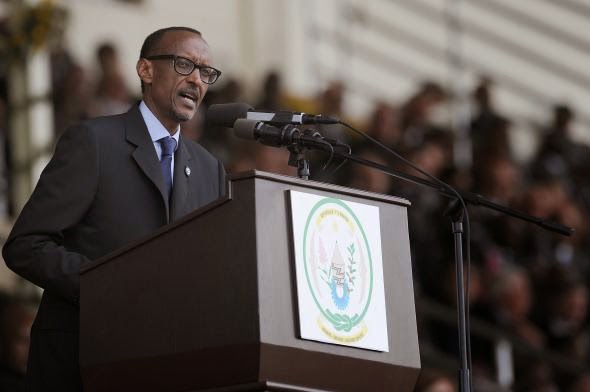
The speech delivered by President Paul Kagame at the 20th Commemoration of the Genocide against the Tutsi

I am mindful that Rwanda and it's leadership have some critics. Don't we all? I am comfortable with the discussion and debate, for by it, we move closer and closer to mutual understanding. Fan or foe, every person who chooses to participate in the discussion should give careful consideration to the speech delivered yesterday by President Kagame to a packed stadium, which included Heads of State (and former Heads of State), the Secretary-General of the United Nations, Church leaders and other dignitaries from around the world, including thought leaders in genocide education and prevention.

It most certainly is not my place to add or subtract from the words of President Kagame. However, one brief clue to context: Two days before this Commemoration of worldwide significance, France chose to boycott the event to which it was invited and had planned to attend. Why? France's boycott was a protest to President Kagame's very calm, factual reference during an interview that France and Belgium played historically significant roles in the preparation of the Genocide, and France was actually somewhat of an accomplice. This is a very well understood historical fact, understood and acknowledged by all observers except sensitive, guilt-ridden French leaders who choose to deny the facts. President Kagame is both clear and gracious in noting that the facts are the facts, and we cannot change them, nor can we be well-equipped to move forward and avoid future genocides unless we acknowledge and learn from them. I was present when the speech was delivered, and can attest that it was delivered with calm humility, and there was no element of accusation or condemnation.

***********************************************************************************************

Speech by President H.E. Paul Kagame at the 20th Commemoration of the Genocide against the Tutsi
Kigali, 7 April 2014

•       Excellencies Heads of State and Government;
•       Excellency Secretary-General of the United Nations;
•       Excellency Chairperson of the African Union Commission;
•       Former Heads of State and Government;
•       Distinguished Government Officials from around the world;
•       Esteemed Guests;
•       My Fellow Rwandans:

I don’t have enough words to express my appreciation to all of you, who have come from near and far to be with us, on a day as important as this. I also thank all of those who have stood with us in Rwanda’s incredible journey of rebuilding.

We are gathered here to remember those who lost their lives in the Genocide and comfort those who survived.

As we pay tribute to the victims, both the living and those who have passed, we also salute the unbreakable Rwandan spirit, to which we owe the survival and renewal of our country.

To our parents, children, brothers, and sisters who survived — to Rwandans who defied the call to genocide and to those who give voice to their remorse — it is you who bear the burden of our history.

We have pursued justice and reconciliation as best we could. But it does not restore what we lost.

Time and again these past twenty years, Rwandans have given of themselves. You have stood before the community to bear witness and listened to others do the same. You have taken responsibility and you have forgiven.

Your sacrifices are a gift to the nation. They are the seed from which the new Rwanda grows. Thank you for allowing your humanity and patriotism to prevail over your grief and loss. Thank you very much.

Historical clarity is a duty of memory that we cannot escape. Behind the words “Never Again”, there is a story whose truth must be told in full, no matter how uncomfortable.

The people who planned and carried out the Genocide were Rwandans, but the history and root causes go beyond this country. This is why Rwandans continue to seek the most complete explanation possible for what happened.


We do so with humility as a nation that nearly destroyed itself. But we are nevertheless determined to recover our dignity as a people.

Twenty years is short or long depending on where you stand but there is no justification for false moral equivalence. The passage of time should not obscure the facts, lessen responsibility, or turn victims into villains.

People cannot be bribed or forced into changing their history. And no country is powerful enough, even when they think that they are, to change the facts. After all, les faits sont têtus.

Therefore, when we speak out about the roles and responsibilities of external actors and institutions, it is because genocide prevention demands historical clarity of all of us, not because we wish to shift blame onto others. And those others should have their moment to be humble in the face of historical facts.

All genocides begin with an ideology — a system of ideas that says: This group of people here, they are less than human and they deserve to be exterminated.

The most devastating legacy of European control of Rwanda was the transformation of social distinctions into so-called “races”. We were classified and dissected, and whatever differences existed were magnified according to a framework invented elsewhere.

The purpose was neither scientific nor benign, but ideological: to justify colonial claims to rule over and “civilise” supposedly “lesser” peoples. We are not.

This ideology was already in place in the 19th century, and was then entrenched by the French missionaries who settled here. Rwanda’s two thousand years of history were reduced to a series of caricatures based on Bible passages and on myths told to explorers.

The colonial theory of Rwandan society claimed that hostility between something called “Hutu”, “Tutsi”, and “Twa” was permanent and necessary. This was the beginning of the genocide against the Tutsi, as we saw it twenty years ago.

With the full participation of Belgian officials and Catholic institutions, this invented history was made the only basis of political organisation, as if there was no other way to govern and develop society.

The result was a country perpetually on the verge of genocide.

However, Africans are no longer resigned to being hostage to the world’s low expectations. We listen to and respect the views of others. But ultimately, we have got to be responsible for ourselves.

In Rwanda, we are relying on universal human values, which include our culture and traditions, to find modern solutions to our unique challenges.

Managing the diversity in our society should not be seen as denying the uniqueness of every Rwandan. If we succeed in forging a new, more inclusive national identity, would it be a bad thing?
We did not need to experience genocide to become a better people. It simply should never have happened.

No country, in Africa or anywhere else, ever needs to become, quote, unquote, “another Rwanda”. But if a people’s choices are not informed by historical clarity, the danger is ever present.

This is why I say to Rwandans — let’s not get diverted. Our approach is as radical and unprecedented as the situation we faced.

The insistence on finding our own way sometimes comes with a price. Nonetheless, let’s stick to the course.

To our friends from abroad — I believe you value national unity in your own countries, where it exists. Where it doesn’t, you are working to build it, just as we are.

We ask that you engage Rwanda and Africa with an open mind, accepting that our efforts are carried out in good faith for the benefit of all of us.

For those who think that for Rwanda, or Africa to be governed properly by its people, by the leaders chosen by these people still requires their endorsement, they are still living in a too distant past.

We want you to know that we appreciate your contributions, precisely because we do not feel you owe us anything.

Rwanda was supposed to be a failed state.

Watching the news today, it is not hard to imagine how we could have ended up.

We could have become a permanent U.N. protectorate, with little hope of ever recovering our nationhood.

We could have allowed the country to be physically divided, with groups deemed incompatible assigned to different corners.

We could have been engulfed in a never-ending civil war with endless streams of refugees and our children sick and uneducated.


But we did not end up like that. What prevented these alternative scenarios was the choices of the people of Rwanda.

After 1994, everything was a priority and our people were completely broken.
But we made three fundamental choices that guide us to this day.

One — we chose to stay together.

When the refugees came home — we were choosing to be together.

When we released genocide suspects in anticipation of Gacaca — we were choosing to be together.

When we passed an inclusive constitution that transcends politics based on division and entrenched the rights of women as full partners in nation-building, for the first time — we were choosing to be together.

When we extended comprehensive new education and health benefits to all our citizens — we were choosing to be together.

Two — we chose to be accountable to ourselves.

When we decentralise power and decision-making into the towns and hills across the country — we are being accountable.

When we work with development partners to ensure that their support benefits all our citizens — we are being accountable.

When we award scholarships and appoint public servants based on merit, without discrimination — we are being accountable.

When we sanction an official, no matter how high-ranking, who abuses their power or engages in corruption — we are being accountable.

As a result, our citizens expect more from government, and they deserve it.

Three — we chose to think big.

When Rwandans liberated our country — we were thinking big.


When we created Rwanda’s Vision 2020 and committed to meeting our development goals — we were thinking big.

When we decided to make Rwanda attractive for business — we were thinking big.

When we invested in a broadband network that reaches all our 30 districts — we were thinking big.

When we became a regular contributor to United Nations and African Union peacekeeping missions — we were thinking big.

We may make mistakes, like every country does. We own up and learn and move forward.

There is more hard work ahead of us than behind us. But Rwandans, we are ready.

A few years ago, at a commemoration event, I met a young man who was one of the twelve people pulled alive from under 3,000 bodies in a mass grave at Murambi.

He still lived nearby, totally alone. When the perpetrators he recognised came home from prison, he was understandably terrified.

When I asked him how he managed, he told me: “I could not do it unless I was convinced that these impossible choices are leading us somewhere better.”

Twenty years ago, Rwanda had no future, only a past.

Yet as Fidel told us just now, today we have a reason to celebrate the normal moments of life that are easy for others to take for granted.

If the Genocide reveals humanity's shocking capacity for cruelty, Rwanda's choices show its capacity for renewal.

Today, half of all Rwandans are under 20. Nearly three-quarters are under 30. They are the new Rwanda. Seeing these young people carry the Flame of Remembrance, to all corners of the country over the last three months, gives us enormous hope.

We are all here to remember what happened and to give each other strength.

As we do so, we must also remember the future to which we have committed ourselves.


I thank you.

Sunday, June 30, 2013

Massacre at Murambi


We in Rwanda are now approaching the end of the 100 Days of Remembrance, which is observed each year to (1) honor the 1,000,000 who died so needlessly, (2) demonstrate compassion for survivors who suffered great loss and deep wounds, and (3) declare "Never Again!" As we endeavor to come to grips with the Rwandan Genocide and our own responsibility, spending 5 minutes 21 seconds watching this short video can be a profound experience. Please click here: Massacre at Murambi

I have been to Murambi twice and have spoken with some of the very few survivors. I have watched this video several times and am ever moved, forever pierced by it. 

I have a very bright friend who is a great student of words, communication, rhetoric, and argumentation. Although I have not actually had the conversation with him, I can quite easily hear his voice: "Tom, this video is a most extreme form of rhetorical propaganda,... an appeal to the emotions."  My response: "Okay, but you say that as though you have a problem with it. Yes, it hits hard, but show me where it is wrong. What is untrue or misleading?"


Monday, June 17, 2013

"Sexual corruption"

Sometimes just the right word is needed to gain clear understanding, to actually "get it." When that right word is introduced, it becomes an a-ha moment.

Except in the most extreme cases, I was often slow, dense, dimwitted in taking seriously the notion of "sexual harassment." Harassment is something a youngster feels when told to do Kumon, or a teenager when told to get off the phone and take out the trash, or a young spouse when told by the other spouse that they should not spend so much time playing softball. But adults who were created as sexual creatures saying what they think, being what they are? Well, I "sorta got it" (sorta), but it seemed to me that the complaining "victim" could have/should have stood on principle and personal choice and resisted.

Leave it to Rwanda to edify me and draw me from my dark ignorance,... Rwanda, a country of empowered women, where 56% of Parliament are women, as are many Members of Cabinet, including the "Minister of Gender." Rwanda, an African nation with "Zero tolerance of corruption," and it was the elaboration and application of this "Zero tolerance of corruption" that brought me new understanding.

I recently read an article in a Rwandan newspaper explaining that "sexual corruption is a crime in Rwanda." Corruption? We hate corruption and will NOT tolerate it! "Sexual corruption?" What's that?

Like it or not, sex is a negotiation (unless it is actually rape, in which case the perpetrator dispenses with the negotiation). Even in marriage. But when one party wields an unfair power advantage over the other, it is no longer a real negotiation but instead oppressive, exploitative, and "corrupt,"... and criminal. Realistically, there may be no "personal choice." The notion of the movie producer's "casting couch" might have formerly given rise to some ignorant fascination or perverse amusement, but the exploitation of a young Rwandan seeking a job (where so few exist) simply enrages. And it can get even worse: Imagine the young mother desperate for alms so she can feed her baby. Which term gets the job done: "sexual harassment" or "sexual corruption"?

I encourage those in the West who care about this subject to consider a change of terminology so that they and their cause might be better understood. The newspaper article opined that: "If all institutions - from the Police, Parliament, legal and religious institutions, civil society and the private sector, and individuals - collaborate in the efforts to tackle sexual corruption, it will be stopped." [Emphasis added.]


Thursday, May 9, 2013

A change of mind


Have you had a dramatic "change of mind" about something, anything, in the past year? The past 10 years? If not, I must either applaud you for having it all so fully figured out, OR express my sorrow for your death of which you may be unaware. I was quite struck when I once heard that if I haven't changed my mind about anything in years, then apparently I am no longer thinking, or growing, or even living. This raises a great question for us to ask one another. So pour two glasses of wine and ask your spouse, or friend, or parent or adult child: "Tell me about something on which your thinking has dramatically shifted (presumably “evolved”) in recent years. Perhaps you will hear about a shocking change of political party registration (and I don't care which direction). Or a change in position on drug laws, or abortion, or same-sex marriage, or the Second Amendment and gun control, or gender issues, or the Middle East (and again, I am not anxious or quick to judge the position; I am most fascinated by the fact of change and how and why it came about.) 

I am happy to have experienced a few dramatic changes of mind on some significant matters. To explain would require much more than is appropriate for a blog post. But this notion of "Oh, how I have changed" occurred to me on an insignificant matter the other day:

I once placed great confidence in my Vitamin C, echinacea, ginkgo biloba, St. John's wort, acai berry, and wheatgrass. At this same time, I thrived happily (and made a good living) in a litigious culture where civil claims for damages were proffered at a rate far exceeding one per second. Some were claims by homebuyers and tenants who alleged injury and damage due to "toxic black mold" which may have been sniffed out by a specially trained "black mold dog" or scientific equipment resembling a Geiger counter. When discovered, the house would essentially be "Red Tagged" and a lawsuit filed.

My life was good, but I now I live differently, in a different culture, in a home where mushrooms grow in the place of non-existent baseboards. (The mushrooms started growing only after I got the upper hand on the mice that previously trampled upon the spores as they ran track around the room perimeter.) So I looked upon these mushrooms growing in my bedroom and thought, "Hmmm, how I have changed, but I feel just fine." BTW: Vitamin C, echinacea, ginkgo biloba, St. John's wort, acai berry, and wheatgrass are unavailable to me here in Rwanda and I do without. In truth, I now think of such "nutritional supplements" as silly witchcraft. I know and respect that many of you strongly disagree, but I simply eat fresh and local, and again, I feel just fine. 

Can you eat what grows up from your bedroom floor?
Post Script: I knew I was making a regrettable mistake as I typed the words "silly witchcraft." I confess that I am prone to strong over statements for which I must later seek forgiveness and better explain myself. Responsive emails came within minutes after I posted those words. 
I certainly do not mean "witchcraft" as in "from the dark side." Nor do I mean that ALL such "nutritional supplements" are totally fraudulent. But I do believe that we are inclined to put much greater faith in their efficacy than is supported by reliable research. Echinacea and massive doses of Vitamin C are not likely to harm me, but nor will they cure my cold in 18 hours (unless I am to get well within 18 hours anyway, in which event I swear to their effectiveness). Indeed, the latest studies conclude our love affair with echinacea and Vitamin C (which began with Linus Pauling) is without scientific basis. I find it most interesting that (1) we spend billions of dollars on such nutritional supplements (billions that could be much better spent), and (2) we use such nutritional supplements with great intellectual pride for living at the forefront of the latest scientific discoveries, as we look condescendingly upon those in undeveloped countries who practice curious traditional medicine. We too practice the same traditional medicine. Some of it may be helpful; some of it is probably pure superstition.

Sunday, April 28, 2013

"WE MUST LEARN FROM HISTORY." Trite. Seemingly hopeless. Critically important.


Each year Rwanda commemorates the 1994 Genocide Against the Tutsi. The commemoration boosts and reinforces Rwanda’s mantras for itself and the world, “Never Forget!” and “Never Again!” As everyone in Rwanda knows and feels, we are presently within the 100 days during which the genocide occurred 19 years ago.
I am not the judge of the facts of what is occurring in Syria. But the facts matter, and President Obama knows them, whatever they are. The facts may be very “inconvenient.” But certain facts give rise to legal obligations that simplify the arguments that insist that our moral obligations are “complicated” and multi-faceted, with competing concerns. No one is more horrified than me by the thought of U.S. military engagement in Syria. But I am even more horrified by the thought that the U.S. could again stand idly by, impotent, deaf, dumb, and blind, as genocide occurs, breaching our legal obligation under the Genocide Convention of 1948, when we too swore “Never Again!”
"Please, never forget."


Please read Anne-Marie Slaughter’s Opinion in today’s Washington Post, and be alert to the facts and our legal (and moral) obligations,… and be prepared to be vocal and courageous whenever, wherever genocide occurs. Slaughter writes:
The Rwanda genocide began in April 1994; within a few weeks, nongovernmental organizations there were estimating that 100,000 Tutsis and moderate Hutus had been massacred. Yet two months later, Reuters correspondent Alan Elsner and State Department spokeswoman Christine Shelly had an infamous exchange:
Elsner: “How would you describe the events taking place in Rwanda?”
Shelly: “Based on the evidence we have seen from observations on the ground, we have every reason to believe that acts of genocide have occurred in Rwanda.”
Elsner: “What’s the difference between ‘acts of genocide’ and ‘genocide’?”
Shelly: “Well, I think the — as you know, there’s a legal definition of this. .. . Clearly not all of the killings that have taken place in Rwanda are killings to which you might apply that label. ... But as to the distinctions between the words, we’re trying to call what we have so far as best as we can; and based, again, on the evidence, we have every reason to believe that acts of genocide have occurred.”
Elsner: “How many acts of genocide does it take to make genocide?”
Shelly: “Alan, that’s just not a question that I’m in a position to answer.”
As President Obama and his advisers look for “more conclusive evidence” that Syrian leader Bashar al-Assad has used chemical weapons against his people, he would do well to remember this shameful moment. The evidence Obama is reviewing first surfaced in December, when the U.S. consul in Istanbul sent a cable detailing interviews with victims and observers of an attack in Homs just before Christmas and concluding that it was likely that the Syrian government had used chemical weapons.
The reported evidence was of paralysis, muscle spasms, seizures, blindness, hallucinations and disorientation. Victims reportedly responded well to atropine, a drug used to treat people exposed to the nerve gas sarin. This was very inconvenient for an administration determined not to get more involved in Syria, however, so U.S. officials said in early January that the Syrian government had used a “riot control agent.” Similar evidence has been squelched again and again, until finally our allies — the British, the French and even the Israelis — forced our hand.
The Clinton administration did not want to acknowledge that genocide was taking place in Rwanda because the United States would have been legally bound by the Genocide Convention of 1948 to intervene to stop the killing. The reason the Obama administration does not want to recognize that chemical weapons are being used in Syria is because Obama warned the Syrian regime clearly and sharply in August against using such weapons. “There would be enormous consequences if we start seeing movement on the chemical-weapons front or the use of chemical weapons,” he said. “That would change my calculations significantly.”
Unfortunately, changing the game is hard. Moreover, even against the reported recommendations of his advisers, Obama has shown little interest in intervention in Syria beyond nonlethal assistance to some opposition forces, diplomatic efforts with Russia and the United Nations, and political maneuvering to try to unify the opposition.
But the White House must recognize that the game has already changed. U.S. credibility is on the line. For all the temptation to hide behind the decision to invade Iraq based on faulty intelligence about weapons of mass destruction, Obama must realize the tremendous damage he will do to the United States and to his legacy if he fails to act. He should understand the deep and lasting damage done when the gap between words and deeds becomes too great to ignore, when those who wield power are exposed as not saying what they mean or meaning what they say.
The distrust, cynicism and hatred with which the United States is regarded in much of the world, particularly among Muslims across the Middle East and North Africa, is already a cancer. Standing by while Assad gasses his people will guarantee that, whatever else Obama may achieve, he will be remembered as a president who proclaimed a new beginning with the Muslim world but presided over a deadly chapter in the same old story.
The world does not see the complex calculations inside the White House — the difficulty of achieving any positive outcomes in Syria even with intervention, the possible harm to Obama’s domestic agenda if he plunges into the morass of another conflict in the Middle East. The world would see Syrian civilians rolling on the ground, foaming at the mouth, dying by the thousands while the United States stands by.
Mr. President, how many uses of chemical weapons does it take to cross a red line against the use of chemical weapons? That is a question you must be in a position to answer.
May there never again be cries from the grave:
"We thought you would come as you said you would."


Thursday, April 4, 2013

For a cause

We should each ask: For what am I living? To really live – and not merely exist – requires fully embracing a worthy cause for which one would give up their life. If I lack such a passionate commitment, I am merely another cow in the pasture, taking up space, consuming, and making a mess.
That being said, it is equally noteworthy that "The mark of an immature man is that he wants to die nobly for a cause, while the mark of a mature man is that he wants to live humbly for one." Wilhelm Stekel, quoted by J.D. Salinger in The Catcher in the Rye.
Let us live humbly yet passionately, "intentionally," with purpose and meaning.

Monday, March 25, 2013

Good Observance of Good Friday - The Passion of the Christ

As H. Richard Niebuhr wrote 75 years ago, we are so inclined to believe that “a God without wrath brought men without sin into a kingdom without judgment through the ministrations of a Christ without a cross.” Kingdom of God in America [1937], p. 193. (I encourage you to take a minute to unpack that very dense sentence.)


For decades I labored under a similar miscomprehension: "Okay. So Christ died on the cross for me. Nice. But he is God, so just how painful could it have been?" Well, Scripture teaches us that it was incomprehensibly horrible. We cannot imagine the betrayal, the humiliation, the physical pain, the loneliness and total abandonment. But in my effort to try to imagine, I find it helpful to observe Good Friday (March 29, 2013) by re-watching The Passion of The Christ, a profound, intense way to pause on Good Friday and reflect upon Christ's work and suffering on the cross.

So was Christ's death on the Cross really necessary?!? Could God not have accomplished the same result by some other means? Perhaps he could have, but he didn't. At the great risk of oversimplification, allow me to summarize the reason for Christ on the Cross:

God is perfectly holy and righteous.

God is also a perfectly just Judge, and perfect justice cannot ignore any wrongs.

God also loves us, and desires to enjoy intimate fellowship with us, which reveals much about God, and little about me.

For I am not holy or righteous, and my sin separates me from such fellowship with a loving and/but just God,... unless the price is paid for my sins.

Among my sins is my failure to acknowledge and appreciate God's love for me, and what he has done for me. The Passion of The Christ forces me to face into and reflect upon how great is that love and how high was the price,... and how shall I respond.

It was once explained to me this way: I should imagine being brought before the Court to face the undeniable charges for my many offenses (sins). An omniscient, perfectly just Judge, who cannot compromise his perfect justice, considered my offenses and pronounced the only appropriate sentence: "Death." But the Judge called me "son," and although the just sentence had to be imposed, the Judge stood, stepped down from his Bench, removed his robe, and received his just sentence in my stead. Perfect justice was preserved; perfect love was demonstrated; that I may be redeemed, set free, and be forever transformed by such perfect love.

This Friday is Good Friday, and I encourage you to join me in watching The Passion of The Christ.


For God so loved the World...